Showing posts with label community. Show all posts

Wednesday, April 30, 2008

Speaking of funding...


I was invited recently to participate on a panel regarding fundraising in the arts. I was told by the organizer that I was being invited for my experience in fundraising for the HighWaterLine project. I told them, you know I only raised about 30% of the cost of the project and funded the rest of it independent filmmaker style (credit cards) and am still working on ways to recoup, so I'm not sure I am the best representative. They said, actually that's the other reason we have invited you, we want someone who is honest about their fundraising achievements and challenges.

I'm pretty excited about the panel, since, as you may have noticed, I am really interested in talking about new funding models.
I think there are a couple of important parts of the conversation around fundraising which need to be addressed, I will look at value/integration and support of artistic communities today...

First, how we talk about value of the arts in a community. The argument on the monetary value of the arts, while valuable and of great merit is overused and doesn't fully address all of the facets of a strong arts economy. I just read a good article in the New York Times Magazine about arts in education, it profiles a report which debunks the power of the arts in strengthening skills in the "tested" subject areas. (I've had a problem with this argument for a while). Instead it notes that what was witnessed was: "persistence in tackling problems, observational acuity, expressive clarity, reflective capacity to question and judge, ability to envision alternative possibilities and openness to exploration." (Nowhere has this been made more visible to me than the week I spent at ACPA, where high school students undertook a week long art project with me where they solved problems, collaborated, focused and expressed).Similarly it is important to find ways to talk about the broader impact that the arts has on our community psyche and collective consciousness. What does it mean culturally and socially to be a creative community?

And what does all this have to do with arts funding? It's re-framing the argument and looking deeper at the value of the arts and encouraging broader support, which gets us back to the other facets of a healthy funding environment for the arts. While city, state, and federal support of the arts combined with private support giving money or resources to both organizations and individuals provides fertile ground, an active patronage also needs to exist to help create a sustainable environment (somebody has to buy the work/tickets/etc).

The final (and possibly most complicated) pieces are both government regulation in support of arts (low rent/tax breaks for venues and orgs, housing subsidy for artists, open permitting and city agency support) and integration of arts and artists into private sector economy.
The integration could occur in a variety of ways - one idea I like is to hire artists within the corporate community to inspire creative thinking. I guarantee that if you put me on your board of directors that I would be able to see things from a different point of view and come up with creative solutions. Within the private sector artists have the ability to inspire the creativity necessary to advance companies. I would also advocate for institutions to host, essentially, artist residencies. I could provide a number of inspiring community based projects to help with any variety of Nature Conservancy, Sierra Club or NRDC initiatives.

Tomorrow I will write about creating a supportive artistic community, as an artist, and how we can help each other overcome the scarcity myth.

Images courtesy of Creative Commons on Flickr (from top to bottom):
"Fund Public Art" by bourgeoisbee
"Funds Please" by otherthings
"Creative Hands - Mindy" by Dalydose
"fuck it i'll fund that." by yatta

Thursday, April 24, 2008

Thinking outside the box

crossposted from seedingthecity.org

I like to approach projects from an "outside the box" (boy, thats an overused term) point of view. When I mentioned the "Seeding the City" to a friend who works with green roofs, he questioned the value of planting such a small plot of greenery - how is that going to have any real affect on the Urban Heat Island Effect?

May answer, "Each individual module may have a negligible affect, but what would hundreds of modules spread across the city do to both our environment, our awareness and our social fabric?"

When you consider the potential of the project, creating potentially enough greenery on rooftops to recreate a Central Park in the sky? Now it gets interesting.

I have also been considering how to raise money for the project outside of the "normal" channels (i.e. grants). A couple of things have come up recently which I am investigating:

  • ThePoint.com is a tipping point model for fundraising and social action. Get enough people to commit to something, and then it can happen. I posted the project on there with enough funds to launch the project, its a pretty high price, so we will see how close I get, but it does allow many people to be involved at a small level - it is a further exploration of microfinancing.

  • Another idea is to exchange money for experience or special commodities from the project, this is based on the model of artistshare.com. The funding is given up front and then the funders are invited to participate in interesting ways throughout the project.

  • Finally, my own thought of allowing people to "sponsor" grm's throughout the city. Pay $50 and you would sponsor a grm in your choice of one of the neighborhoods. This wouldn't be on your own roof, but would include your sponsorship information on the signage and website.


So, does anyone have any thoughts on any of this? Are there ways you would want to participate financially? Would you give a small amount for nothing in return or prefer a larger amount and a unique experience or commodity (if so what would that experience or commodity be?) or would you prefer to know that your funds are directed at a specific piece of action?

Friday, April 11, 2008

Artists Pivotal in Art World

I was scheduled to participate in the show "EcoAeshtetics" at <>Tag in The Hague. As I mentioned, they invited me to do a project which would activate people in the streets and were interested in flying me out to create a citywalk next weekend. I wasn't interested in the ecological footprint of the flight, so had developed and entirely new and exciting project, Insert ___ Here, which would require them to do the printing of the materials and organize the citywalk and uploading of images. I had also allowed them to (if they wanted) recruit some local designers to work on the remediation images.

Today it was canceled due to their very busy schedules.

I am sad about that, but it also brings into stark reality something I have talked about before (I don't mean to disparage <>Tag at all, they were very supportive of the artists in the show - offereing airfares, stipends, etc, so please don't think I am speaking badly of their decision), the role of the artist as the hardest working in the art world. Without me producing the materials, flying out to lead the walk, managing the upload of images, searching out designers and managing their work and reposting of all of the images, well, the work just doesn't get done. This on top of already thinking through the idea, writing text, designing signs, creating a website, researching materials... As so often happens, the artist not only must create the work, but also do all the work to get it shown. Often without a living wage renumeration. This while all the other people who work in the gallery system are getting paid either a stable salary or an hourly wage which covers all their time.

Not to worry though, Insert ____ Here is launching next week with the help of PS58 in Brooklyn (check out the kids blog on climate change - Little Grassroots!) and will be at the Sustainable South Bronx Block Party on May 17th. If you are interested in getting a group together to do "Insert ____ Here" in your city, email me at eve at insert-here dot org!

Tuesday, April 08, 2008

Flights of Fancy

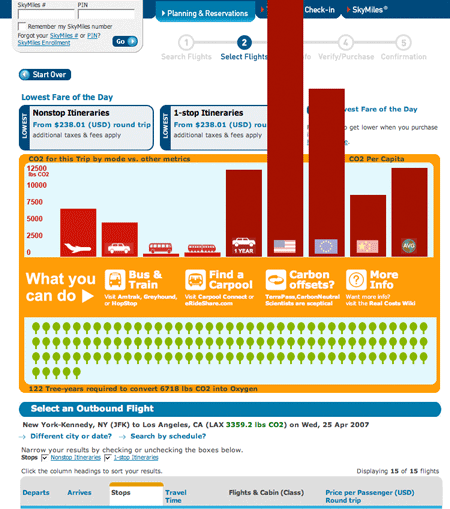
Another blog I read just turned me on to RAF-Reduce Art Flights, a project launched at the Venice Biennial. The project aimed to highlight and promote the reduction of travel in the art world. With all the art fairs there's been an increase in not just in travel, but an exponential increase in shipping of artwork.

This project hits close to home, especially given a couple of recent experiences. As I would hope, as my career grows, I have more opportunities to travel with/because of my work. On the other hand, I don't want to create a negative environmental impact with the work. And airline flights (if you didn't already know) have HUGE carbon emissions. So how to keep the career growing, spread the work and minimize the impact?

Recently I was invited to the Wexner Center to present my work as part of the Art & Environment program. It was a one afternoon engagement. I explained the quandary to the director, and asked if there was a way to broaden my (positive) impact while there, could she work with the school or other organizations to fill up a week? She was happy to oblige. I spent a week working with a local group of extraordinary high school students (more on that later), spent the afternoon at the Wexner, and met with local artists. Believe me the week was packed full.

(I was also reminded - again - of our desperate need for better rail. The only train was a 12 hour trip arriving at 3.30am in a city two hours away, the bus left at 4am. I was totally up for taking on the long trip and early arrival, but as anyone who has ridden any distance knows, the freight trains are given priority and passenger trains are notoriously late. If I missed the 4am bus I would have been awkwardly stranded).

So in the case of Wexner it opened up lots more opportunities for me to meet with and work with people.

The other instance was that I was invited to participate in the EcoAesthetics exhibition at < > TAG platform in The Hague. They were interested in bringing in an artists who would get out into the public space and create interventions or activate public participation. Well, thats me for sure! Unfortunately I *really* couldn't justify a flight to The Hague for a weekend project*. So instead I suggested that I create a project that could occur in the public realm, but which they could produce, organize and promote all themselves. I would provide the creative idea, the structure and the electronic files, everything else was (mostly) up to them. From that was born the "Insert ____ Here" project which will launch in The Hague this weekend, Brooklyn next weekend and then Miami and the Bronx soon after. I would love to see it happen in neighborhoods around the world, so certainly contact me, or watch the project site (totally in progress- just a theme place holder for the moment) for more information.Link

In light of this, I have been talking with Michael Mandiberg and Tiffany Holmes (of ecoviz.org) about creating a group of artists who are interested in participating in and promoting an electronic panel. We could be in our homes, in front of a web cam participating in a panel anywhere in the world. If Andy Revkin can do it, so can we.


*It's not that I don't want to go to these places - I definitely do, I love travel and I love meeting people around the world, but I am trying to be conscientious about my travel footprint - reducing the flights and if I do fly, packing the time full of opportunities.

Images (from top to bottom): Michael Mandiberg's Real Cost plugin for Mozilla Firefox, Eve S. Mosher's "Insert ____ Here" project

Friday, February 08, 2008

I <3 community walk

When you work on projects that involve a lot of mapping, you learn to love mapping tools. There may be better ones out there, but I have grown fond of Community Walk. I just used them to do a quick map of the Highbridge project, I See You in Me (The Path of Water in NYC):

CommunityWalk Map - I See You in Me / The Path of Water in NYC

I did it mostly to get a guess of how long the project will need to be, about a mile. Sure after a more than 70-mile long project, it seems easy, but this one is a little more work intensive...

More images/information on the project.

Thursday, February 07, 2008

Why (and how) we share

I've talked before about the collective power of artists and why we should share. I've been seeing it repeated on Sellout and in the comments over there recently too. (Basically it is the idea that by sharing resources and knowledge we can actually create a greater wealth of opportunities and resources). In light of that, I was trying to figure out the best way to share those resources with one another. Of course a forum seems like the obvious answer - but that can easily become unweildy and devalues quickly. (It would be hard to replicate the success of chow nee chowhound).

I will start by offering what I know here in these pages...
I will start with the basics, some good places to get reference materials-
  • Fractured Atlas: Good place to learn more (professional development), get more (fiscal sponsorship, health insurance, liability insurance [for events, film production & public art], publicize (promote & learn marketing), and get some member discounts.
  • Sellout: Participate in an ongoing discussion regarding artist issues.
  • Chicago Artist Resource: a fantastic site with loads of information and interviews for artists everywhere (most of the content is not location specific). Check out articles and links to other resources on your practice (incl. health & safety, health insurance links, public art, community & social issue arts, magazines & journals, and a great collection of artist and art professional's stories), career (incl. strategic planning, marketing & promotion, community, organizations & unions) and business (incl. branding, financial planning, legal issues, and advocacy)
  • NYFA: New York Foundation for the Arts is a great site (you have to register to use it) which provides an international listing of resources, called NYFA Source. It is a searchable database of residencies, grants, space, apprenticeships, etc). They also list classifieds - jobs & opportunities.
  • International Sculpture Center: Given that the definition of 'sculpture' has expanded to include installation, video and some time-based works, these resources are for more than sculptors. They host a sculptor community forum, artist's registry, and resources.
  • Artists Space: The most useful (anecdotally) non-fee based, uncurated online image registry.
  • Artist Career Guide: Right now it is mostly a promo site for Jackie's upcoming book, but she is posting interviews with professionals semi-regularly (currently there are interviews with two curators), but it also lists workshops she is teaching - and she can definitely whip your under-promoted butt into shape.
Anyone know of others I should include?

Note to self, other posts should include: grant writing tips, making sticky websites, the theory of becoming an expert, online fundraising...

In trade, anyone know a financial planner who works with artists (needs to know our particular situation) based here in NYC?

Found the image on: http://www.business-improvement.org/.

Monday, November 26, 2007

When art becomes "something useful and or valued"

com·mod·i·ty : \kə-mä-də-tē\
Function: noun | Inflected Form(s): plural - com·mod·i·ties | Etymology: Middle English commoditee, from Anglo-French commoditee, from Latin commoditat-, commoditas, from commodus | Date: 15th century
1: an economic good: as a: a product of agriculture or mining b: an article of commerce especially when delivered for shipment <commodities futures> c: a mass-produced unspecialized product <commodity chemicals> <commodity memory chips>
2 a: something useful or valued commodity patience>; also: thing, entity b: convenience, advantage
3: obsolete: quantity, lot
4: a good or service whose wide availability typically leads to smaller profit margins and diminishes the importance of factors (as brand name) other than price
5: one that is subject to ready exchange or exploitation within a market

I was recently asked to explain how I am able to create (fund and find audience for) the kind of work that I do. This question was from someone who a) is professionally interested in managing creative careers and making money (sustainable art) and b) who is steeped in more traditional models within the visual arts world, but has some knowledge in new methods of distribution and funding in the literary, film and music industries. So let's break this down.
First, the kind of work that I do: I create (in addition to a more traditional studio based practice) temporary, performative based public artworks. Some have sculptural aspects and all have a community building and/or eco-visualization aspect. Most of these projects do not produce a single representative object which can be bought or sold. I am currently using the term "non-object based work." I use this to describe my work and the work of some friends of mine. Some other examples are, Lise Brenner, a choreographer whose most recent projects include a choreographic charting of native flora in Brooklyn which resulted in directions which could be applied to a performance as the final product (not an actual performance) and a historical investigation of a neighborhood through sound work and tours. Aaron Landsman is a performer who created a sound work that was a tour of a day in the life of a neighborhood and a performance which is produced in individual's apartments. Stephanie Skaff whose recent project was a street performance in which she set up a street vendor cart in Lower Manhattan to share stories from street vendors around NYC (it was the culmination of months of going out and meeting and speaking to many many vendors around the city). None of these artists' works result in specific objects which can be bought or sold and neither of them have set up situations which are subject to ticketing for a traditional performance.

Now it should be noted that we are not in a unique situation. There are numerous historical precedence to all that we are doing: Richard Long's Walks, William Pope L.'s performance/crawls, numerous earthworks (Smithson's Spiral Jetty, Michael Heizer's Double Negative, Walter de Maria's Lightening Field, the list goes on), a variety of conceptual artworks and even some dadaist non-object based work. So it's not like we don't have a point of reference.

Second, who is this for: The work that I and many of my contemporaries working in a "non-object based" way is done in such a way as to engage a larger audience than one might find in a traditional gallery or performance space. In a sense, we are preaching way beyond the choir. Whether it is someone passing by on the street in Canarsie as I draw the chalk line with whom I engage in a conversation about climate change or a stockbroker who never thought twice about his daily stop at the coffee cart until he met with Stephanie. So the projects are all really broad based and interested in participating in a wider social discussion.

Third, what is the current funding? Currently, most of these projects are funded through foundations and municipal or state funds. In my case, almost 50% of my project time is taken up through grant applications and writing. I am sure it is similar in other cases as well. This funding is really wonderful as it comes as a project based monetary amount, with no strings attached and - here's a nice thing you may not know - most (if not all) funders require that you include in your budget an artists fee. They want to know that they, in supporting the project, are supporting the artist. If you have been a lucky (is that the right word? its quite a lot of work for it to be luck) recipient of a grant, then you that you will be required to do periodic reporting on how the money is being spent and what is happening with the project. Other than that, don't expect a whole lot of interaction (unless you get a Creative Capital grant). The granting agency doesn't interfere with the work, nor do they, though, provide much formal support. Some might profile your project in their outreach, some might provide feedback, but mostly it is up to the recipient to make the project succeed or fail.

A portion of the funding may also come from private donations - frequently made up of "friends and family grants" and - euphemism - "self-funding." These sources may ebb and flow based on project frequency and/or outside competition for money. While it is frequently true that if you ask someone for a donation they will give it, it is also true that it is hard to repeatedly hit up the same people without any reward.
And as much as I like to believe in the abundance of funds available to artists, grants are definitely limited. And with some recent changes in the world of major funders, the money available is shrinking. So we are looking for new ways to create sustainable careers.

The commodity model: This model implies a specific object of value which can be traded in exchange for money. The traditional gallery/dance/performance system is based on trade. You give me money, I give you an object or a specified moment of time which is valued based on the opinions of others. This model is heavily dependent on a) an object or ticketed performance b) the perceived value of your creation (perceived by people other than the artist). For those of us working outside of the traditional object based practice, we can produce sale-able items (for example I have the beacons, documentary photos and maps, Stephanie has CD's of her conversations with street vendors - although I think she gave those away for free), but the goal of the practice is not the object - therefore the value of the object is often diminished.

A new funding model: I don't have an answer for this yet. It is what all this thinking is leading up to. However there are a lot of new models out there for other practices and funds:
  • artistshare.com - this new model allows music fans to directly participate in the creation of new music/cd's. a patron can donate to the musician and in return receive anything from a glimpse inside the recording process, to attending a recording session to being an executive producer on the album
  • artist pension trust - using artworks as investment, this trust accumulates works of many artists and distributes revenue from art sales to all artists
  • self-publishing/distribution for literature, films & music - more sites are popping up making it easier to manage your own career in these media, including lulu.com, withoutabox, cdbaby...

So I am thinking about how to create a new paradigm for supporting the arts - is it modeled as a mix between artistshare, artist pension trust and creative capital grantmaking? If you have specific thoughts, or want to join in the larger conversation (I am putting together a group of interested individuals to have a larger discussion), then leave a comment.


images from top to bottom:
yves klein, "jumping into the void"
aaron landsman, image from "Gatz" performance by Elevator Repair Service
lise brenner, matrix from "The City from a Plant's Perspective: Mapping NYC as Native Flora"
michael heizer, "double negative"
richard long, "a line made by walking"
eve s. mosher, "HighWaterLine"
stephanie skaff, "Make Me One with Everything"

Monday, October 01, 2007

Who let them in?


One thing I have to remind myself is that "public art" has inherently, the word "public" in it.

This has been really driven home during the installation of the beacons during the HighWaterLine project. I have placed the beacons in 5 city parks (sorry that I never got to redo Canarsie) spanning the coast of Brooklyn and Lower Manhattan. Most of the installations were fairly peaceful and a nice opportunity to talk to people about New York City and climate change.

Every one of the installations involved at least one act of "public interaction." At the very first installation in Corlear's Hook Park, a gentleman was looking at the beacon, then knelt down, pulled the beacon out of the ground (it is staked on 4 corners) and removed the flashlight in the base. I was standing about 60 feet away and called out, "would you mind putting that back?" he did so, and quietly tried to restake the beacon, all without saying a word.

When I installed in Battery Park a few people would walk up, and without even pausing to look closely at the beacon, grabbed it and roughly shook it back and forth. Much like you would a snowglobe. I have had a lot of opportunity to ponder this, and cannot for the life of me understand what is the point of this activity. To me it is the equivalent of walking up to a friend, seeing that they are wearing an interesting shirt and then grabbing it and pulling them roughly about as if to see if the shirt is going to fall apart in my hands.

This activity, let's call it snowglobing (sounds vaguely rude), has happened at least once in every installation of the beacons, but the real test was the weekend long installation that just occurred as part of the Dumbo Art Center's Art Under the Bridge Festival. This massive art festival consists of installations, performances and projections and general insanity around Dumbo. There are probably around 20-30,000 people who pass through the area over the weekend. I installed the beacons on Friday afternoon and took them out on Sunday evening. Over the weekend the beacons were more than snowglobed, they were knocked down, moved, emptied, turned over, altered and pieces stolen. I don't even want to consider what might have happened that moved one beacon (and the wet, 20 pound bags of sand) about 10 feet from its original location.

Every time I visited they were in disarray. I was sometimes shocked, but mostly amused with a hint of annoyance. I calmly went about resurrecting them, often with the assistance of some kind onlookers. I should make a point that most people are very respectful of the work and treat it carefully, enjoying it in a non-threatening way and ensuring the work is left in tact for other to also enjoy. This was not the case however when a friend and fellow public artist went to visit the work in Brooklyn Bridge Park during the festival. She was so sickened by the obnoxious treatment (including a parent who watched their child knock it about, eventually toppling it) that she had to leave immediately.

So, not to disparage what is obviously a strong and fairly common urge, but if there is anyone out there who has participated in a snowglobing type of activity, we on the art making side of the fence would love to know more about why this is done...

Wednesday, September 19, 2007

Being in love with the crazy

Last week was kind of a nutty week. I was part of a group show opening at Nelson Hancock Gallery in Dumbo, Topos : Brooklyn, showing images of the HighWaterLine project. All very great there were some really interesting projects/images there, including works by Tim Connor, Rebekah Farley, Michael Iacovoni, Michael Itkoff, Michael Piazza, Michael Simon, and Torrance York. Here's where th crazy comes in, for some reason I had in my head that the opening was this week. So when I talked to Nelson and found out otherwise, Ed & I switched into overdrive to get things figured out. We met Nelson on Saturday morning to see the space and work out what we were going to show. We came up with the idea of doing a 3 1/2" x 170" scroll of many images (37) from the project. I also wanted to put up maps of the upcoming weekends - there were three weekends still to happen after the opening - and then replace the maps with images after the weekend's drawings. Nelson loved both ideas, so we were sent off on our way to get it done and back to them by Wednesday morning for installation.

Saturday afternoon I had made plans with my friends Peter & Cecile to go see the Mike Nelson "A Psychic Vacuum" at the Essex Market (courtesy of Creative Time). It was a good break to take - the installation is fantastic, and really does play with your psyche - time, space emotions are all in there. And I really loved the last space. I won't spoil it, just go see it. It is open until October 28th.
So Saturday evening/Sunday morning I had to sort through all of the photos and pick out about 40 that I wanted to use. Then I met at 10am on Sunday (yeh, I have no weekends anymore) with Ed to pick out the final images and get them in order. I also was making cd's of a bunch of images that I hadn't yet gotten from Ed. Around 1pm I ran home to eat some lunch (and see g-pup, pup-pup and puppykat). Then back over to the studio to meet with our color corrector/printer, Taylor. He and I worked out the schedule to get things back to the gallery on time. The cd's I was trying to copy at the studio were also taking ages to copy. So I left them copying to come home for dinner, then went back to finish copying them. Around 9ish I came back home and sorted through the images and pulled them into photoshop to put them in strips to pass off to Taylor by Monday 9am. So I stayed up until about 1:30am getting it all in order (with the help of g-pup). Woke up the next morning nice and early to walk pup-pup to get myself into the city by 9am to pass off the disc to Taylor before heading off to the day job.

Taylor worked some serious magic on color correcting the images and was ready to review them Monday evening. So I was over in the studio again with Ed & Taylor getting the images in order and ready for the final print. We were supposed to finish the printing that night, but ran out of paper at about midnight! Tuesday Ed got more paper and was going to print the scroll on his printer that evening. Around 7ish he realized his printer wouldn't print something as long at 170" (some epson thing), Taylor was at the photo studio where he could print something that long, but didn't have the files. I ran over to the studio, burned a disc, jumped on a train and headed into the city to hand off to Taylor at about 10pm. Taylor stayed up late (again) getting two prints off for me. I came back into the studio Wednesday morning at 9am and picked up the prints (thanks to Gerard for his help too) and delivered them to the gallery. Whew.

Then Thursday I walked over 14 miles to do the chalking out on the shore parkway. Then took a shower and ran over to the opening. Friday I was up early to do the chalking in Sunset Park Industrial area, then back to the studio, where I was on the phone with the Parks Dept to get the permit in order for Sunday (they had lost the application, but thanks to Eddie & Nancy in Special Events, they got it worked out for me). I ran up to Litchfield Villa, then back home again for a shower and heading into the city for Cynthia's opening and the preview of the Canary Project images.

Again on Saturday an early morning out chalking in Gowanus - it was a gorgeous day for it after the rain moved off. Then jumping on my bike for a windy ride over to the Conflux Festival for the Eyebeam Eco-Visualization Challenge Panel. Where I had the joy of sitting on a panel with some pretty smart, clever and creative people: Amanda McDonald Crowley, Tiffany Holmes, Michael Mandiberg and Brooke Singer. From there I jumped back on my bike to head into Union Square to help my friend Steve with his project, Ronald's Crisis. Back home (great day for a bike ride over the Williamsburg Bridge) to upload images and blog about the weekend.

Sunday another early start out finishing the chalking in Gowanus, joined by my friend Margo, who biked from Washington Heights to South Brooklyn (I love you!). We chalked and then had a fab lunch at the Red Hook soccer fields. Peter and Hose came out to help and document respectively, the installation at the soccer fields. With the help of the kids in the area, I installed the beacons. Which, you should know, consists of carrying the pieces (base, beacons, spikes, flashlight) to the site, laying them out, putting them together, hammering the spikes into the ground, then filling each with 1/3 gallon of water, and cap them all. It's not at all a short task and can be physical. We spent about 2 1/2 hours installing them all (and having 3 broken in the process - no big deal I had 50% overage made, thanks to a suggestion years ago from a prepator who worked with Chihuly who regularly brings 15-25% overage for breakage during installation). After photographing them, I found out the people I thought were coming out that afternoon to help out, weren't going to make it. So I was stuck. I had more chalking to do and it was going to be about 3-4 hours to dark. In Battery Park I was okay to leave the beacons installed while I chalked, but Red Hook was a much more active area and leaving them unattended wasn't going to be a good idea. So, I de-installed them (I know, crazy). Then Hose and Peter left and I did a few more blocks of chalking in Red Hook. Then I went back to the studio to unload, then back to the house to unload the beacons (they live in the apt right now) and pick up g-pup who was going to help me re-install a handful of beacons for the night time portion of the project. So I went back out, re-installed and photographed again. Luckily there was a group of girls who were there during the day that were still there. They got to see the installation at night, and really loved it - having them huddled around the beacon totally made it worthwhile to have come back out to reinstall.Sunday night and Monday were spent uploading images and updating the blogs and websites. Monday afternoon I met Cecile again to try to go catch Stephanie Skaff's street performance, Make Me One With Everything. The performance on Monday had been canceled, so we couldn't find her. (I am going to try to catch it again this morning on my way into the city - after dropping off packets at Nelson Hancock and visiting BBPark to site the beacons).

So this is a REALLY long story to explain one thing - when the crazy is about something you love, then you even love the crazy. I was writing an email to someone this morning outlining the upcoming weekend's work and realized that there will be a couple more crazy days coming up. I paused to think about it and it got me a little excited (despite still being tired from the recent crazy). I really really love creating the projects, I love doing my art, even the crazy. If you don't love what you are doing - then why are you doing it? Do the things that make you crazy but only if you are in love with that crazy. I am in love with my crazy. (Can't wait to spend some time in studio though too!)

Tuesday, September 11, 2007

My water tower dream

Where I work I have a great view (if I turn around and strain a bit) of a lot of NoHo, East Village rooftops. From here I can see the buildings dotted with water towers. I love water towers.

One day when I was looking at the roofs while contemplating the Green Seeds project, I thought - whoa - wouldn't those water towers look great swathed in green? It would be so cool to turn them into vertical farms. Heck Rachel Whiteread cast one in resin, why can't I turn a few of them into community gardens?

I had developed a proposal when I was in SF called the Vertical Community Gardens, or VCG's. The idea was to create a superstructure that could be hung in place of the advertisements on the buildings of walls (in SF they are low, at eye level) and maintained and used by the communty.
This is an offshoot of that, only it would be used by the people in the building. I was reading on the Vertical Farm site about their urban farm projects. Maybe they would help build a flexible ultra lightweight water tower superstructure to use as small starter projects. There are three right on the corner of Houston and Crosby that I would love to do. And hey I can see them from my office window!


On another note, if you haven't already, go see the Mike Nelson Creative Time project, A Psychic Vacuum, in the old Essex Market building. It is really hard to explain, but the psychology of space, place and time is really played with here. Spoiler alert -- the last space is quite extraordinary, particularly after having been through the maze of other spaces.

Images (from top to bottom) courtesy of: City Noise, Vertical Farm - Design by Chris Jacobs.

Wednesday, August 15, 2007

Turning waves into power


Some smart person was sitting looking at the water, watching the undulations and reflections and was smart enough to realize that if they harnessed that energy...

I'm not that smart person, but I am glad they are out there. Instead, I tend to lend my brain to creative pursuits. Albeit hopefully creative pursuits that have a goal, or actionable outcome. So lately, as the High Water Line project continues along (just finished Lower Manhattan - so its back to Brooklyn!), I have been contemplating a couple of things.

First, what to do next. I have a lot of ideas I am playing with, which I will outline below.

And second, how to capitalize on all the media attention around the High Water Line. An artist whom I admire, Chris Doyle, speaks of his first big public art project, Commutable, and he was asked, "Are you ready?" by one of his presenting organizations. When he asked what they meant, they said "Are you ready for all of the attention you will get around this, and will you be able to use that to continue to build your career?"

So I was very conscious of that going into this project, particularly as the attention continued to grow. And I have to ask myself? Am I ready? I thought I was. I have concepts for the next project, I am definitely making use of the fantastic network of people that I have met over the course of the project. But how, realistically does one turn that attention into funding or other types of support for the next project? I'm not sure that I know. So now what?

Well, what I am doing now is working on the next thing... hopefully I can take it a little slower and ensure more up front funding and get all of the ducks in a row earlier in the process. So here is the roster of projects (all with *working* titles and there fore subject to change).

Green Seeds
Background: This project builds off the history of gardening in NYC as well as the connections to food which are long established in the Lower East Side and Chinatown. It also examines the heat island effect, and the mitigation which even a small portion of something like a green roof can play on the temperature of the city. Finally it utilizes social networking to generate siting the project.
Green roof: I have been gathering information on green roofing and have found a modular and lightweight system which can be used without a lot of retrofitting or heavy construction etc. My idea is to take one or two of the modular pillows and place them on roofs. They then act as a *seed* of a green roof. They might (I'm working on this) housed in a sculptural element (the seed pod?) that could also contain instruments for measuring temperature (which could be sent back to an online map), a solar panel to power the instrumentation, provide some weight and protection for the green roof and perhaps provide some visual cues about the green roof.

Social networking: The social networking is accomplished as follows. 1. I find the first person on whose roof I place the first green seed pod. I then get the necessary approval from the landlord, and ask the resident to meet or find one or two people in a neighboring building that are also interested in having the project installed. Again I go through the necessary approvals and install the second green seed pod, asking those residents to again find the next set of interested participants. I would also like to install them in some more public spaces like schools and public rooftop areas. From these locations people could inquire and request green seed pods.

How to make it public: Here's one of the tricky parts. How to make the project *more* public. Since the roofs might be a majority privately owned, access isn't really a possibility. The mapping and temperature taking will be publicly accessible, but how else can I do it? Do I literally run string from one green seed pod to the next, showing the network as it grows? (But what does that really have to do with green roofs?) Do I create little plaques (like historical markers) that can be affixed to the front of the buildings? Do I recreate George Bliss' Purple Footprints (once used to lead to Adam Purple's community garden, and then later to protest the Bowery Bar) - but that's illegal...

Okay, I was supposed to write them all up, but now I am going to be late for work, so I will add the rest (Coffee Cup Reduction Project, Real Cost Cafe and What a Waste - Disposable Culture) later...