Showing posts with label climate change. Show all posts

Thursday, April 24, 2008

Thinking outside the box

crossposted from seedingthecity.org

I like to approach projects from an "outside the box" (boy, thats an overused term) point of view. When I mentioned the "Seeding the City" to a friend who works with green roofs, he questioned the value of planting such a small plot of greenery - how is that going to have any real affect on the Urban Heat Island Effect?

May answer, "Each individual module may have a negligible affect, but what would hundreds of modules spread across the city do to both our environment, our awareness and our social fabric?"

When you consider the potential of the project, creating potentially enough greenery on rooftops to recreate a Central Park in the sky? Now it gets interesting.

I have also been considering how to raise money for the project outside of the "normal" channels (i.e. grants). A couple of things have come up recently which I am investigating:

  • ThePoint.com is a tipping point model for fundraising and social action. Get enough people to commit to something, and then it can happen. I posted the project on there with enough funds to launch the project, its a pretty high price, so we will see how close I get, but it does allow many people to be involved at a small level - it is a further exploration of microfinancing.

  • Another idea is to exchange money for experience or special commodities from the project, this is based on the model of artistshare.com. The funding is given up front and then the funders are invited to participate in interesting ways throughout the project.

  • Finally, my own thought of allowing people to "sponsor" grm's throughout the city. Pay $50 and you would sponsor a grm in your choice of one of the neighborhoods. This wouldn't be on your own roof, but would include your sponsorship information on the signage and website.


So, does anyone have any thoughts on any of this? Are there ways you would want to participate financially? Would you give a small amount for nothing in return or prefer a larger amount and a unique experience or commodity (if so what would that experience or commodity be?) or would you prefer to know that your funds are directed at a specific piece of action?

Tuesday, April 08, 2008

Flights of Fancy

Another blog I read just turned me on to RAF-Reduce Art Flights, a project launched at the Venice Biennial. The project aimed to highlight and promote the reduction of travel in the art world. With all the art fairs there's been an increase in not just in travel, but an exponential increase in shipping of artwork.

This project hits close to home, especially given a couple of recent experiences. As I would hope, as my career grows, I have more opportunities to travel with/because of my work. On the other hand, I don't want to create a negative environmental impact with the work. And airline flights (if you didn't already know) have HUGE carbon emissions. So how to keep the career growing, spread the work and minimize the impact?

Recently I was invited to the Wexner Center to present my work as part of the Art & Environment program. It was a one afternoon engagement. I explained the quandary to the director, and asked if there was a way to broaden my (positive) impact while there, could she work with the school or other organizations to fill up a week? She was happy to oblige. I spent a week working with a local group of extraordinary high school students (more on that later), spent the afternoon at the Wexner, and met with local artists. Believe me the week was packed full.

(I was also reminded - again - of our desperate need for better rail. The only train was a 12 hour trip arriving at 3.30am in a city two hours away, the bus left at 4am. I was totally up for taking on the long trip and early arrival, but as anyone who has ridden any distance knows, the freight trains are given priority and passenger trains are notoriously late. If I missed the 4am bus I would have been awkwardly stranded).

So in the case of Wexner it opened up lots more opportunities for me to meet with and work with people.

The other instance was that I was invited to participate in the EcoAesthetics exhibition at < > TAG platform in The Hague. They were interested in bringing in an artists who would get out into the public space and create interventions or activate public participation. Well, thats me for sure! Unfortunately I *really* couldn't justify a flight to The Hague for a weekend project*. So instead I suggested that I create a project that could occur in the public realm, but which they could produce, organize and promote all themselves. I would provide the creative idea, the structure and the electronic files, everything else was (mostly) up to them. From that was born the "Insert ____ Here" project which will launch in The Hague this weekend, Brooklyn next weekend and then Miami and the Bronx soon after. I would love to see it happen in neighborhoods around the world, so certainly contact me, or watch the project site (totally in progress- just a theme place holder for the moment) for more information.Link

In light of this, I have been talking with Michael Mandiberg and Tiffany Holmes (of ecoviz.org) about creating a group of artists who are interested in participating in and promoting an electronic panel. We could be in our homes, in front of a web cam participating in a panel anywhere in the world. If Andy Revkin can do it, so can we.


*It's not that I don't want to go to these places - I definitely do, I love travel and I love meeting people around the world, but I am trying to be conscientious about my travel footprint - reducing the flights and if I do fly, packing the time full of opportunities.

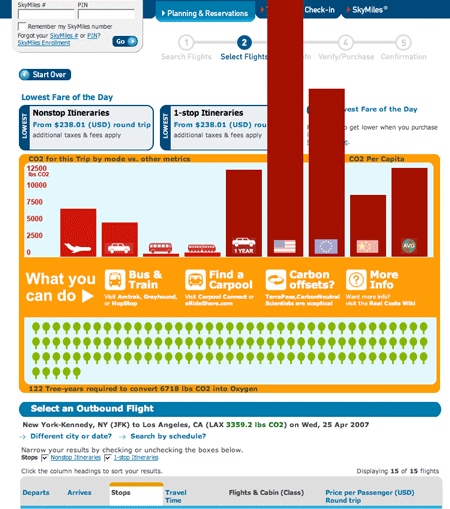
Images (from top to bottom): Michael Mandiberg's Real Cost plugin for Mozilla Firefox, Eve S. Mosher's "Insert ____ Here" project

Monday, October 01, 2007

Who let them in?


One thing I have to remind myself is that "public art" has inherently, the word "public" in it.

This has been really driven home during the installation of the beacons during the HighWaterLine project. I have placed the beacons in 5 city parks (sorry that I never got to redo Canarsie) spanning the coast of Brooklyn and Lower Manhattan. Most of the installations were fairly peaceful and a nice opportunity to talk to people about New York City and climate change.

Every one of the installations involved at least one act of "public interaction." At the very first installation in Corlear's Hook Park, a gentleman was looking at the beacon, then knelt down, pulled the beacon out of the ground (it is staked on 4 corners) and removed the flashlight in the base. I was standing about 60 feet away and called out, "would you mind putting that back?" he did so, and quietly tried to restake the beacon, all without saying a word.

When I installed in Battery Park a few people would walk up, and without even pausing to look closely at the beacon, grabbed it and roughly shook it back and forth. Much like you would a snowglobe. I have had a lot of opportunity to ponder this, and cannot for the life of me understand what is the point of this activity. To me it is the equivalent of walking up to a friend, seeing that they are wearing an interesting shirt and then grabbing it and pulling them roughly about as if to see if the shirt is going to fall apart in my hands.

This activity, let's call it snowglobing (sounds vaguely rude), has happened at least once in every installation of the beacons, but the real test was the weekend long installation that just occurred as part of the Dumbo Art Center's Art Under the Bridge Festival. This massive art festival consists of installations, performances and projections and general insanity around Dumbo. There are probably around 20-30,000 people who pass through the area over the weekend. I installed the beacons on Friday afternoon and took them out on Sunday evening. Over the weekend the beacons were more than snowglobed, they were knocked down, moved, emptied, turned over, altered and pieces stolen. I don't even want to consider what might have happened that moved one beacon (and the wet, 20 pound bags of sand) about 10 feet from its original location.

Every time I visited they were in disarray. I was sometimes shocked, but mostly amused with a hint of annoyance. I calmly went about resurrecting them, often with the assistance of some kind onlookers. I should make a point that most people are very respectful of the work and treat it carefully, enjoying it in a non-threatening way and ensuring the work is left in tact for other to also enjoy. This was not the case however when a friend and fellow public artist went to visit the work in Brooklyn Bridge Park during the festival. She was so sickened by the obnoxious treatment (including a parent who watched their child knock it about, eventually toppling it) that she had to leave immediately.

So, not to disparage what is obviously a strong and fairly common urge, but if there is anyone out there who has participated in a snowglobing type of activity, we on the art making side of the fence would love to know more about why this is done...

Wednesday, September 19, 2007

Being in love with the crazy

Last week was kind of a nutty week. I was part of a group show opening at Nelson Hancock Gallery in Dumbo, Topos : Brooklyn, showing images of the HighWaterLine project. All very great there were some really interesting projects/images there, including works by Tim Connor, Rebekah Farley, Michael Iacovoni, Michael Itkoff, Michael Piazza, Michael Simon, and Torrance York. Here's where th crazy comes in, for some reason I had in my head that the opening was this week. So when I talked to Nelson and found out otherwise, Ed & I switched into overdrive to get things figured out. We met Nelson on Saturday morning to see the space and work out what we were going to show. We came up with the idea of doing a 3 1/2" x 170" scroll of many images (37) from the project. I also wanted to put up maps of the upcoming weekends - there were three weekends still to happen after the opening - and then replace the maps with images after the weekend's drawings. Nelson loved both ideas, so we were sent off on our way to get it done and back to them by Wednesday morning for installation.

Saturday afternoon I had made plans with my friends Peter & Cecile to go see the Mike Nelson "A Psychic Vacuum" at the Essex Market (courtesy of Creative Time). It was a good break to take - the installation is fantastic, and really does play with your psyche - time, space emotions are all in there. And I really loved the last space. I won't spoil it, just go see it. It is open until October 28th.
So Saturday evening/Sunday morning I had to sort through all of the photos and pick out about 40 that I wanted to use. Then I met at 10am on Sunday (yeh, I have no weekends anymore) with Ed to pick out the final images and get them in order. I also was making cd's of a bunch of images that I hadn't yet gotten from Ed. Around 1pm I ran home to eat some lunch (and see g-pup, pup-pup and puppykat). Then back over to the studio to meet with our color corrector/printer, Taylor. He and I worked out the schedule to get things back to the gallery on time. The cd's I was trying to copy at the studio were also taking ages to copy. So I left them copying to come home for dinner, then went back to finish copying them. Around 9ish I came back home and sorted through the images and pulled them into photoshop to put them in strips to pass off to Taylor by Monday 9am. So I stayed up until about 1:30am getting it all in order (with the help of g-pup). Woke up the next morning nice and early to walk pup-pup to get myself into the city by 9am to pass off the disc to Taylor before heading off to the day job.

Taylor worked some serious magic on color correcting the images and was ready to review them Monday evening. So I was over in the studio again with Ed & Taylor getting the images in order and ready for the final print. We were supposed to finish the printing that night, but ran out of paper at about midnight! Tuesday Ed got more paper and was going to print the scroll on his printer that evening. Around 7ish he realized his printer wouldn't print something as long at 170" (some epson thing), Taylor was at the photo studio where he could print something that long, but didn't have the files. I ran over to the studio, burned a disc, jumped on a train and headed into the city to hand off to Taylor at about 10pm. Taylor stayed up late (again) getting two prints off for me. I came back into the studio Wednesday morning at 9am and picked up the prints (thanks to Gerard for his help too) and delivered them to the gallery. Whew.

Then Thursday I walked over 14 miles to do the chalking out on the shore parkway. Then took a shower and ran over to the opening. Friday I was up early to do the chalking in Sunset Park Industrial area, then back to the studio, where I was on the phone with the Parks Dept to get the permit in order for Sunday (they had lost the application, but thanks to Eddie & Nancy in Special Events, they got it worked out for me). I ran up to Litchfield Villa, then back home again for a shower and heading into the city for Cynthia's opening and the preview of the Canary Project images.

Again on Saturday an early morning out chalking in Gowanus - it was a gorgeous day for it after the rain moved off. Then jumping on my bike for a windy ride over to the Conflux Festival for the Eyebeam Eco-Visualization Challenge Panel. Where I had the joy of sitting on a panel with some pretty smart, clever and creative people: Amanda McDonald Crowley, Tiffany Holmes, Michael Mandiberg and Brooke Singer. From there I jumped back on my bike to head into Union Square to help my friend Steve with his project, Ronald's Crisis. Back home (great day for a bike ride over the Williamsburg Bridge) to upload images and blog about the weekend.

Sunday another early start out finishing the chalking in Gowanus, joined by my friend Margo, who biked from Washington Heights to South Brooklyn (I love you!). We chalked and then had a fab lunch at the Red Hook soccer fields. Peter and Hose came out to help and document respectively, the installation at the soccer fields. With the help of the kids in the area, I installed the beacons. Which, you should know, consists of carrying the pieces (base, beacons, spikes, flashlight) to the site, laying them out, putting them together, hammering the spikes into the ground, then filling each with 1/3 gallon of water, and cap them all. It's not at all a short task and can be physical. We spent about 2 1/2 hours installing them all (and having 3 broken in the process - no big deal I had 50% overage made, thanks to a suggestion years ago from a prepator who worked with Chihuly who regularly brings 15-25% overage for breakage during installation). After photographing them, I found out the people I thought were coming out that afternoon to help out, weren't going to make it. So I was stuck. I had more chalking to do and it was going to be about 3-4 hours to dark. In Battery Park I was okay to leave the beacons installed while I chalked, but Red Hook was a much more active area and leaving them unattended wasn't going to be a good idea. So, I de-installed them (I know, crazy). Then Hose and Peter left and I did a few more blocks of chalking in Red Hook. Then I went back to the studio to unload, then back to the house to unload the beacons (they live in the apt right now) and pick up g-pup who was going to help me re-install a handful of beacons for the night time portion of the project. So I went back out, re-installed and photographed again. Luckily there was a group of girls who were there during the day that were still there. They got to see the installation at night, and really loved it - having them huddled around the beacon totally made it worthwhile to have come back out to reinstall.Sunday night and Monday were spent uploading images and updating the blogs and websites. Monday afternoon I met Cecile again to try to go catch Stephanie Skaff's street performance, Make Me One With Everything. The performance on Monday had been canceled, so we couldn't find her. (I am going to try to catch it again this morning on my way into the city - after dropping off packets at Nelson Hancock and visiting BBPark to site the beacons).

So this is a REALLY long story to explain one thing - when the crazy is about something you love, then you even love the crazy. I was writing an email to someone this morning outlining the upcoming weekend's work and realized that there will be a couple more crazy days coming up. I paused to think about it and it got me a little excited (despite still being tired from the recent crazy). I really really love creating the projects, I love doing my art, even the crazy. If you don't love what you are doing - then why are you doing it? Do the things that make you crazy but only if you are in love with that crazy. I am in love with my crazy. (Can't wait to spend some time in studio though too!)

Wednesday, August 15, 2007

Turning waves into power


Some smart person was sitting looking at the water, watching the undulations and reflections and was smart enough to realize that if they harnessed that energy...

I'm not that smart person, but I am glad they are out there. Instead, I tend to lend my brain to creative pursuits. Albeit hopefully creative pursuits that have a goal, or actionable outcome. So lately, as the High Water Line project continues along (just finished Lower Manhattan - so its back to Brooklyn!), I have been contemplating a couple of things.

First, what to do next. I have a lot of ideas I am playing with, which I will outline below.

And second, how to capitalize on all the media attention around the High Water Line. An artist whom I admire, Chris Doyle, speaks of his first big public art project, Commutable, and he was asked, "Are you ready?" by one of his presenting organizations. When he asked what they meant, they said "Are you ready for all of the attention you will get around this, and will you be able to use that to continue to build your career?"

So I was very conscious of that going into this project, particularly as the attention continued to grow. And I have to ask myself? Am I ready? I thought I was. I have concepts for the next project, I am definitely making use of the fantastic network of people that I have met over the course of the project. But how, realistically does one turn that attention into funding or other types of support for the next project? I'm not sure that I know. So now what?

Well, what I am doing now is working on the next thing... hopefully I can take it a little slower and ensure more up front funding and get all of the ducks in a row earlier in the process. So here is the roster of projects (all with *working* titles and there fore subject to change).

Green Seeds
Background: This project builds off the history of gardening in NYC as well as the connections to food which are long established in the Lower East Side and Chinatown. It also examines the heat island effect, and the mitigation which even a small portion of something like a green roof can play on the temperature of the city. Finally it utilizes social networking to generate siting the project.
Green roof: I have been gathering information on green roofing and have found a modular and lightweight system which can be used without a lot of retrofitting or heavy construction etc. My idea is to take one or two of the modular pillows and place them on roofs. They then act as a *seed* of a green roof. They might (I'm working on this) housed in a sculptural element (the seed pod?) that could also contain instruments for measuring temperature (which could be sent back to an online map), a solar panel to power the instrumentation, provide some weight and protection for the green roof and perhaps provide some visual cues about the green roof.

Social networking: The social networking is accomplished as follows. 1. I find the first person on whose roof I place the first green seed pod. I then get the necessary approval from the landlord, and ask the resident to meet or find one or two people in a neighboring building that are also interested in having the project installed. Again I go through the necessary approvals and install the second green seed pod, asking those residents to again find the next set of interested participants. I would also like to install them in some more public spaces like schools and public rooftop areas. From these locations people could inquire and request green seed pods.

How to make it public: Here's one of the tricky parts. How to make the project *more* public. Since the roofs might be a majority privately owned, access isn't really a possibility. The mapping and temperature taking will be publicly accessible, but how else can I do it? Do I literally run string from one green seed pod to the next, showing the network as it grows? (But what does that really have to do with green roofs?) Do I create little plaques (like historical markers) that can be affixed to the front of the buildings? Do I recreate George Bliss' Purple Footprints (once used to lead to Adam Purple's community garden, and then later to protest the Bowery Bar) - but that's illegal...

Okay, I was supposed to write them all up, but now I am going to be late for work, so I will add the rest (Coffee Cup Reduction Project, Real Cost Cafe and What a Waste - Disposable Culture) later...

Saturday, May 12, 2007

By the numbers...


I have been thinking about noting the numbers involved in the High Water Line project, and after shifting 3,000 pounds of chalk - yep, you heard that right, 3,000 - now is as good a time as any!

I have had sort of a critical mass of community board meetings and parks meetings happening as the project and the summer holidays (for the community boards) rapidly approaches. So here are some of the numbers so far:

3,000 pounds of chalk moved from the truck into storage
208 ounces of pigment
444 paths drawn on my community walk map
13 community boards
8 community board meetings (so far)
9 parks department representatives
4 DOT representatives
2 NASA scientists
8 grant applications (so far)
50 miles of biking (approximately) the line
10 miles of walking the line
2,000 action packets
2 websites (new one coming soon!)
1 press mention (so far)

And we won't even go into budget and expenses yet...

It seems that a lot of what public art making requires is just plain old persistence. I have learned on this project what it really means to sell your idea and how not to take no for an answer. Don't get me wrong, there have been several times along the way where I have just thought - ugh! why am I even doing this? Then I pick myself up, dust myself off and plow on ahead. I do know that it is going to continue to be a hard process, but it is something that I am really passionate about, and when I do find people who are really excited about the project (the audience at Community Boards) or just plain super helpful - many of the people in city agencies - it can be a great boon to the spirit and buoy me back up again.

Speaking of people excited about the project, I am looking for volunteers to work on the project - so if you love talking to people about climate issues, and want to go for long interesting and meandering walks around NYC - contact me!

There are a couple of more hurdles to clear - the biggest of which is finding space to mix the chalk and pigment. If anyone has some outdoor space, studio space or storage space that they aren't using, don't care if it gets dusty and has access to power - definitely let me know! Special bonus if it has a loading dock. That would certainly be easier than shifting 3,000 pounds of chalk each month.

Top photo of natural pigments, courtesy of The Real Milk Paint Company.

Monday, April 23, 2007

You are cordially invited...


My hope at the beginning of the HighWaterLine project was to take you, my blog reader friends, along for the ride (at least partially). It has turned out that a lot of the work is about emailing, meetings and writing and re-writing proposals and promotions. It turns out that all that stuff isn't so interesting to blog about.

One thing I would like to do though, is to offer the knowledge that I have gained to others out there interested in doing public art projects. Here's where you come in...

First, if you have questions about the process, post away. I am happy to answer any questions people might have about the process - grantwriting, fiscal sponsorship, grant reporting, networking, working with partners, working with city agencies, community boards, fabrication, public outreach, press and marketing, etc. I will provide in-depth answers in whatever you are interested in learning more about.

Second, if you are interested in the process and want to witness some *live action* I have a LOT of community board meetings coming up, let me know if you are interested in learning more about the process, you can join me at one of the meetings. Just go to the highwaterline.org site and contact me.

Finally, if you really really want to get out there and see what it is all about, volunteer! I am looking for artists and environmentally minded folks to walk the line with me. There are a couple of ways to help, so go check out the timeline, and then contact me to let me know when you would like to help out!

(Top image - the glamour of making public art...)

Monday, March 26, 2007

It's a big small world

It has been interesting to work on a project within the specific realm of arts and environmental issues. Is it a subculture or a genre? There are both a lot of people working on these issues and at the same time relatively few.
As I talk to more people about High Water Line, I find more crossover and you start to hear the same names over and over again. I was meeting with a friend at Eyebeam the day after my friends at Solar One were there, then my partners at Canary Project were meeting with Solar One the same afternoon that I was attending the Sea of People fundraiser. An advisor of mine had suggested that I look up Jane Marsching just a couple of days after another friend had put us in touch. Jennifer Monson of iLand and I keep crossing paths, and my designers at Pratt Design Corps are friends with CP's assistant... The list goes on.I had heard the name Alexis Rockman mentioned by the Precipice Alliance, and then again by Cynthia Rosenzweig. Most recently a friend of mine brought up his name after having met with LMCC about her own independent projects. Finally I took a few minutes (in between drawing maps and writing grant applications), to look more in depth at his work. A google image search brings up a huge list of fantastical images. I found some good articles on his work in the NYTimes, Wired and Orion Magazine. He paints this rich and luscious paintings of romanticized demise of the earth from the efforts of man (genetic alteration, global warming, etc). These paintings are layered with imagery of great and small creatures (rarely are humans in the picture - although on occasion). I love the bright colors and the detail and lighting which are imbued in the work. It is an interestingly fantastical image of human degradation of the earth and what comes after. I can't help thinking about how fun it would be to work with him on a 2-d 3-d version of Courses of Empire (the Acadia to Utopia series) that I have wanted to do for a long time. Don't be surprised if in between the next few public projects that I want to do, I squeeze in some time to do a sculptural interpretation of one of his works.
Top image: Dancer in iLand performance
Middle image: Jane Marxhing's Arctic Listening Post
Last three images: Alexis Rockman

Friday, March 23, 2007

Oh and--

If you want to contribute to the High Water Line project (money that is!) you can do so here!

From where I am sitting

A lot going on out in the world including: Ouch! and some good self promotion - this op/ed comes on the heels of me reading more about Brooks' report on "Who Really Cares." And addresses something I have been thinking about ever since seeing the photos of the retreating glaciers. It's something I have been guilty of (am working towards remedying that now) and that I see my friends all around me doing. We believe strongly enough in something to dedicate time and money (despite Brooks' report most people I know give quite generously to charities) and even heated discussions and an occassional rally or march. BUT, how many people are really willing to change their lifestyle, or make sacrifices, or put forth a great effort towards that thing about which they are so passionate?

Sunday, March 18, 2007

Making the change -- we only *think* it's hard


Ever since writing this post, I've been thinking about my own efforts to reduce my impact on the world. As g-pup says, "don't we already have a lower impact than most people?" The answer is yes, we certainly do (we buy locally and seasonally, shop at goodwill for things we need - if we shop at all, we use CFL's, we compost, bring our own canvas bags to the store and recycle, turn off lights, don't run water, won't buy drinks in disposable containers), but I responded, "that doesn't mean we shouldn't do more." So, inspired by the No Impact Man and the book Gone Tomorrow, The Hidden Life of Garbage, we are working to a greater reduction in impact. We are cutting way down on the t.v. that we watch (we don't watch a whole lot already since we hate regular t.v. but we are reducing our watching by about 75%), reducing (trying to get to 0) the packaged goods that we purchase (I will be doing more and more farmer's market shopping since that drastically reduces the packaging and helps with the local buying), and deciding not to buy anything this year - and if we *need* to then we will do some environmental volunteer work to offset that purchase.

I am most looking forward to the efforts towards different types of entertainment, I think we might regain some of the time we seem to be so short on. G-pup is looking forward to doing more homebrewing for his beer consumption. We will still have to rely on transit for getting around (we live in Brooklyn, I work in Manhattan and he works in Jersey), but now that spring is on its way, we will be back on our bikes for most of our shopping and weekend commute needs.

It seems like a lot to take on with the ongoing work on the project, but in a way it all kind of makes sense to do it now...

Sunday, February 04, 2007

the name game

With some feedback from a couple of resources, I am changing the name of the project from "sea Change" to "High Water Line."

I am working to update the website: now at highwaterline.org.

Here's the reason for the name change. Originally conceived as a smaller project, with more of an artistic bent - the cleverness of the name "Sea Change" seemed to suit it well. As the project has grown, and the project becomes more about outreach, public interaction and attention on global warming, a more direct and understandable name was needed. Hence, "High Water Line."

IPCC for you and me....

Favorite IPCC headline (courtesy of Grist) "IPCC, Yeah, you know me"
Favorite footnote in IPCC "Summary for Policy Makers": In this Summary for Policymakers, the following terms have been used to indicate the assessed likelihood, using expert judgement, of an outcome or a result: Virtually certain > 99% probability of occurrence, Extremely likely > 95%, Very likely > 90%, Likely > 66%, More likely than not > 50%, Unlikely < style="font-style: italic;">Very unlikely < style="font-style: italic;">Extremely unlikely < 5%."
Favorite gratuitous scientific term in IPCC SPM: Anthropogenic (from Merriam-Webster: of, relating to, or resulting from the influence of human beings on nature)
Number of acronyms in IPCC SPM (including IPCC and SPM): around 20
Favorite IPCC SPM acronym: LOSU (level of scientific understanding)

So that was a fun read. Nothing really surprising, wouldn't expect there to be with 192 countries having to sign off on it. And this is only the first of four reports. I am holding out for the April release of the affects of climate change (this was the scientific basis report).

Also pretty interesting about Gore getting nominated for a Nobel.

Tuesday, January 23, 2007

seriously? no? seriously?

I know I promised some tips for writing grants to come soon, but things keep happening with the Sea Change project, including a potential name change. I will let you know the details when it gets more fully worked out.
This week g-pup and I were supposed to be flying over to Edinburgh to see some family, but I got hit with that awful cold/flu thing that has been flying around. So there is no way I am getting on a plane with any kind of sinus sickness. (I've done it twice before, it is really not a good idea). So instead I am home working on more of the project needs.
I continue to apply for funding, getting the Greenwall & Jerome Foundation applications together. I am rewriting the application to refocus on the performance aspect of me putting down the chalk line and talking to people one on one about climate change (since thats where the real power is right?) I am also contacting and scheduling meeting with the community boards through which I will be creating the project, its important to get them interested in the project and will help drive interest, understanding and permits.
Am I making any sense at all? My heads a little stuffy.
It all feels like it is moving both quickly and slowly at the same time. I have some really amazing support from all of the fantastic people at Solar One. I have also made some new friends along the way with whom I am trying to create some supportive relationships. I am really looking forward to making this project happen. It is going to be such a fantastic experience. Don't get me wrong - I don't expect it to be all sunshine and daisies (I can't think of the phrase). I know there will be long, hot, lonely days out there. I know there will be discussions with skeptics. I know there will be angry people. But I also hope to interest people who might not be thinking about climate change. Maybe I will influence someone to make a difference in their life, or a difference in many lives. I am really looking forward to meeting all the different people out in the different communities.
Anyway, this is mostly the ramblings of a sinus-y sick person with a stuffy head.

Monday, January 08, 2007

hope springs eternal

Yes, even I will admit that the 70+ weather on Saturday was, in its own absurd way, beautiful. But I couldn't help that it just kept making me mad.It makes me mad that we are seeing, feeling, acknowledging (by we I mean a bigger we than just you an I) climate change, and yet, we are doing so little about it! Mayor Bloomberg, despite his 2030 plan, is still hemming and hawing about congestion pricing (just enact it already!) and refuses to embrace pedestrians, bicycles and mass transit (that includes BRT) as the most important factors in urban planning.
We are experiencing truly bizarre weather around the world, and still the US government refuses to think long term about the auto industry (and standards) the building industry (and standards) and travel and commerce (and standards).
I am also mad that we have given climate change such a misnomer as 'global warming' that almost sounds, well, pleasant. I even overheard on a BBC report some clueless woman (feet on the street kind of thing) talking about how nice it will be for it to be warmer year round, "we all like warm weather" she opines. (I for one actually prefer colder weather). How insane is that? Can we please change the name to something more realistic? I don't know, something like "global ecological disaster" seems to cover it. And as a side note.

Besides that, I think 2007 is going to rock!

Coming soon, more art stuff - like how to write a winning grant proposal! :)

Tuesday, December 26, 2006

Patience is a virtue (and a power)

Wow what a beautiful holiday gift to me! I decided to check the mail on Saturday at our apartment. (We don't get most of our mail here because of the well known Brooklyn mail problems). We got a request for year end donations from the American Museum of Natural History (which, by the way, is my idea one of the most magical places on earth), and a couple of mis-delivered items (see above), and a letter from Brooklyn Arts Council - I mostly thought it was either the newsletter or another appeal for money - in fact it was a promise of money! I got the DCA regrant! So now I am all excited and pumped and working forward on the project - it was a little hard to focus on the holiday celebrations - I was thinking about the Sea Change project and the logistics and calendaring of the project.

So congratulations to me and a huuuuge thanks to BAC for believing in me and the project. I am so excited to be able to say that someone is backing me, it really helps other granters feel like they are not alone in supporting the project (it is a real chicken and the egg scenario).
Today I did some research on the chalk I want to use for marking the line, I have found that the sports field marking chalk is white. I found some good blue chalk powder in the form of the powder used for construction marking (chalk lines - which I always thought was fun to do when I was little - hmm a little premonition?) I was also looking into gulal (the colored powder used for the Indian celebration of Holi) but I don't think it is permanent enough - I want something that will stay around for a couple weeks. Anyone have any ideas?
I also will be building the calendar around the work projects that I have and the travel coming up in the year. My friend over at Solar One just got back from the Al Gore Climate Project training (teaching people to give an effective presentation and giving them the tools). He is hoping to put me in touch with other New Yorkers who attended so that we can coordinate a whole workshop outreach portion of the project - the presentations will be done in partnership with community organizations in the communities through which I will be creating the project.

So now I wait to hear back from NYFA and Cabot, and still have to write letters to Puffin and Jerome...

Thursday, December 14, 2006

In the years to come

There's a lot of buzz about mayor bloomie's 2030 speech, so much so that I will just reblog all that here (they've also got a flashy website):
Worldchanging
Streetsblog (news roundup)
Streetsblog
Gothamist (maps)

And in the realm of responding in a positive manner, here's my nyfa fiscal sponsorship proposal:

I am seeking fiscal sponsorship from the New York Foundation for the Arts to produce Sea Change, a public art installation on the New York City waterfront from June - October 2007. Sea Change will consist of a blue chalk line and light filled markers around Lower Manhattan and along the coastline of the borough of Brooklyn, designating 10-feet above sea level. This “critical line” is the level at which, by the year 2100, nearly annual flooding is predicted to occur as a direct result of climate change.

The blue chalk line of Sea Change will outline the areas at risk to increased cycles of flooding and storm surge resulting from global warming. Along this line, in parks and other high visibility settings, there will be a moveable set of illuminated, water-filled, clear acrylic markers. These markers will be etched with scientific data and easily adoptable tips for a more sustainable lifestyle. Beside the chalk line, information will be stenciled in chalk on the ground. Accompanied by a website, advertising campaign and community-based workshops, Sea Change will provide viewers – residents and tourists – with knowledge to shape the future of their physical environment.

Background. New York, a city of islands and a peninsula, has almost 600 miles of coastline susceptible to the effects of global warming. A large portion of its mass transit system (used by over 4.5 million people per day) and two major airports are at or below the “critical line.” Many of the city’s recreational and tourist destinations - Coney Island, Battery Park, Brooklyn Bridge Park and South Street Seaport - are on the coast. Renewed interest in the waterfront has spurred rapid and massive development in neighborhoods like Greenpoint, Red Hook, Lower Manhattan and Williamsburg. Important municipal services including wastewater treatment, power stations and garbage transfer stations are sited along major waterways. World financial and business centers, including most of Wall Street, are located below the “critical line.” All five of New York’s boroughs are at risk to drastic alteration from the affects of climate change. I have chosen to focus the 2007 project on Lower Manhattan because of its wealth of iconic sites and Brooklyn because of the diverse neighborhoods that will be affected.

Goals. 1) To create Sea Change, a public artwork that maps the “critical line” of projected flood zones along approximately 60 miles of New York City waterfront. The blue chalk line - as it passes through neighborhoods - and the water-filled, light-emitting markers will serve as a poignant reminder of how New York City will be radically affected by climate change. 2) To give viewers a point of entry into a global issue by visualizing its impact at the local level. 3) To use the language of art - e.g., the ephemeral quality of chalk - as a metaphor for vulnerability and change. 4) To conduct a public outreach campaign on the topic of climate change and how individuals can make a difference.

I will draw the 4-inch wide blue chalk line in parks, plazas, and streets, using a device for drawing lines on sports fields. The markers will be 50-100 (3-feet high, 3-inches diameter) recycled plastic acrylic tubes lit with LEDs powered by solar panels and filled with water and will be installed in heavily trafficked areas along the “critical line.” They will be staked in the ground (a low impact installation) and will migrate over time along the blue line. I will move the markers to a new location every two weeks for the duration of the piece. There will be 8 (2-week) settings for the markers in Brooklyn, beginning and ending in Brooklyn Bridge Park. In Lower Manhattan, there will be 3 (4-week) settings. Sites include (in Manhattan) Chinatown, Battery Park and Tribeca; (in Brooklyn) Brooklyn Bridge Park, Red Hook Recreation Area, Shore Road Park, Manhattan Beach, Floyd Bennett Field, Canarsie Beach and Williamsburg.

Allowing time for trouble shooting and interacting with the public, I plan to “draw” an average of 4 miles a day, 1-3 days every two weeks, with the remaining time spent on installation of the markers, outreach and maintenance. As an example, for the first installation of the project (early June 2007) in Brooklyn, I will trace the “critical line” through the Brooklyn Bridge area and install the markers in Brooklyn Bridge Park. The chalk line will begin at Williamsburg Bridge; travel through Vinegar Hill, DUMBO, and on to South Brooklyn Heights. Over the summer and ending in September, the piece will traverse neighborhoods (e.g. Canarsie, Brighton Beach) that are typically underserved, with little access to the arts.

I have already completed extensive research and mapping of the line’s trajectory in relation to public space. In Brooklyn, I will use parks, streets and sidewalks, avoiding private property. In Sunset Park, for example, the line will end on the north side of the piers and begin again on the south side. I have begun the process of seeking permits from the Department of Transportation and the NYC Parks Department. In Lower Manhattan, I will also seek access from developers for the use of plazas or other privately owned public spaces.

Audience. The simplicity of the project, aesthetically and visually, will appeal to people of all ages, ethnicities and economic backgrounds. Sea Change seeks to engage people on the street, in the neighborhoods where they live, work and play. People will encounter the chalk line and the markers while going about their daily lives. The work is an intervention in routine. This aspect of the piece ensures catching people’s attention and providing easy and direct access. Sea Change is designed to engage the community, and promote thoughtful, informed dialogue and action.

Public outreach/dissemination. Scientific data and sustainable living tips will be disseminated to the public through the artwork itself and my presence (with an assistant) in coastal neighborhoods as we execute the piece. I am planning a website and a public outreach campaign consisting of posters on bus shelters, large ads on the sides of buses for routes along the coast and a “poster swipe” (wheat pasted posters) in surrounding neighborhoods. This campaign will attract an audience to the artwork and convey educational information. I have a background in marketing, web design and project management, which I will use to work effectively with designers. The campaign will provide vital information in a visually engaging manner and the website will present in-depth information in an easy to use and easily accessible format.

The website will contain information on the global warming scenarios the scientific community is projecting, as well as local conditions, energy saving tips, and links to numerous other resources. The information included in the various materials will address potential scenarios (for the years 2030, 2050 and 2100) during which significant and measurable change is expected to occur – e.g., by 2030, sea level will rise 6.9-inches to 23.7-inches above current heights; by 2100, annual flood heights could increase dramatically from 3.9-feet to 10.5-feet. The information will be drawn from sources like “Impacts of sea level rise in the New York City metropolitan area,” a frequently cited document produced by representatives of Center for Climate Systems Research, Goddard Institute for Space Studies and the US Army Corp of Engineers. We will also provide sustainable living tips that are location specific – e.g. for Red Hook, low-cost home energy saving tips and the benefits of buying produce in the local farmer's market and for Mill Basin the advantage of solar power and impact of consolidating car trips.

Portions of the ad campaign will target tourists directly, to indicate how actions, no matter where one lives, have an affect on the impact of global warming. Sea Change illustrates for all viewers the “butterfly effect,” the theory that a small change can cause a chain of events leading to larger phenomena. The presence of the chalk line and markers, in conjunction with the website and public outreach campaign, will give communities the knowledge to affect the future shape of New York City.

We are also planning community workshops in partnership with Solar One, NYC’s foremost nonprofit green arts and education center. These workshops are not reflected in my budget, since they will be lead by Solar One. Solar One will create specific programming to teach community members (activists and high school students) to educate others about climate change and lifestyle choices. These trainees will then lead 3-7 workshops for adults at community centers such as Red Hook Recreation Area, Battery Park Conservancy and Salt Marsh Nature Center.

Partnerships. Solar One is the primary partner for outreach through community-based organizations. In addition, the National Press Secretary of the Sierra Club has offered promotional support through their international network.

Timeline. TO DATE: Completely mapped (on paper) the “critical line” – 10-feet above sea level - around Brooklyn and Lower Manhattan. Researched neighborhoods, bus routes, locations, neighborhood landmarks, resources, and community-based organizations (ongoing). Established a partnership with Solar One, NYC’s leading nonprofit focusing on environmental awareness. Submitted proposals for funding from government and private foundations. Secured a pledge of in-kind promotional support from the Sierra Club. Made initial contact, re: permits from the DOE and NYC Parks Dept. and researched required liability insurance. Preliminary research for advertising costs and ad placement, including leads to secure in-kind donations along bus routes in underserved communities. Secured in-kind donation for web design services and domain registration and web hosting.

NOVEMBER 2006 - MAY 2007. Identify high visibility sites. Plan the design, fabrication, and placement of markers. Write text for markers and stencils. Have the markers and stencils fabricated. Hire an administrative assistant. Submit applications for all necessary permits. Continue networking and research to identify funding prospects; initiate contact with potential funders; submit corporate and foundation proposals. Work on website concept and content; hire a web designer. Begin work on ad campaign concept and content; hire outreach campaign designer. Continue work on ad placement, costs, and possible in-kind donations. Collaborate with Solar One to design and plan the community workshops. Develop detailed calendar of chalking and installation with input from community sources. Begin press campaign. Develop detailed plans and schedule for the public outreach campaign. Hire artist’s assistant and installation assistants. Walkthrough/rehearsal for drawing the “critical line.”

JUNE 2007 - SEPTEMBER 2007. Sea Change is enacted in Brooklyn and Lower Manhattan (see details above.)


I have, of course, continued to refine and update the proposal. The recent letter of intent was even more clear and concise than this proposal. (And this one was better than the LMCC and BAC apps). I don't want to keep posting the proposals though, so I will maybe do every other one or something like that. If you have questions about the proposal, the budget, or how you can be involved let me know!

Friday, December 08, 2006

see the difference

I have been dancing around this thought with Sea Change, finally someone who is good at PR found a way to say what I have been thinking. In an interview with Amanda Griscom Little on Grist.com, Richard Branson has this to say:
" What sets climate change apart from these other crises is that most people can't see the problem -- CO2 gases are invisible. If you could see them and they were colored red, 50 years ago it would have looked like a small brush fire smoldering around the world, and today it would look like a wildfire raging across the globe. We desperately need leaders who can help bring visibility and forge solutions to this imperceptible menace before it's too late."
Indeed.